Ar dheis Dé go raibh a anam

May her soul be at the right hand of God
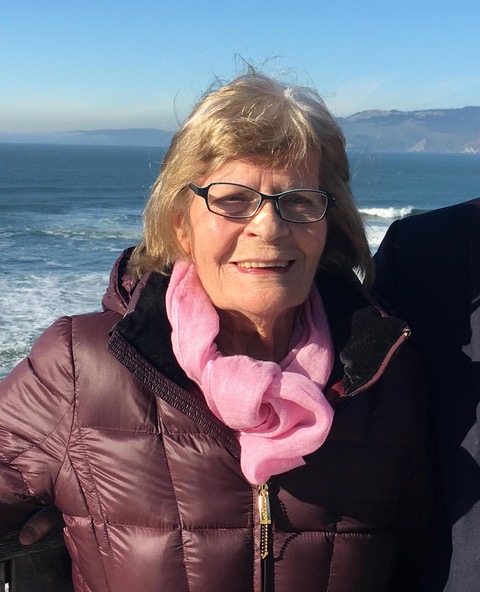
When my friend and H.R. guru Sharon Armstrong asked me where I saw myself in five years, I said, “Studying the Irish language in the west of Ireland.” Never one to shrink from a challenge, Sharon responded, “I have just the person for you.” And that is how I met Eleanor Max.

Eleanor, a native of County Meath, taught Irish on Mondays at the Stoddert School in Glover Park. When I arrived the first evening, I found Eleanor with Pat and Jack, who had been studying with her for a year or two. I introduced myself and sat down. Eleanor showed me the book they were working through and said, “We’ll start over.” I was horrified, “Oh, no. Please continue wherever you are, and I’ll catch up.” Eleanor gave me a look that clearly did not invite a response and said, “No, you won’t.”

She was right. Irish was incredibly hard to start. And it only became slightly less difficult as time went on. But class, which soon moved to Eleanor’s dining room table two blocks away from the school, was fun. Eleanor, Jack, and Pat lived in Glover Park and soon my knowledge of the neighbors was at least as good as my Irish. There was a lot of comhrá, or conversation, mostly in English.

When Eleanor found out I had a love of literature, she invited me to a lecture on Yeats at the Smithsonian. I picked her up in my car, which was at the end of its long life. I told her I had gotten an estimate to fix the air conditioning that was more than the car was worth. “This car owes you nothing,” she declared. Again, I had to agree.

We walked into the lecture hall and found seats halfway back. When the lecturer, a Yeats scholar from an eminent university, was introduced, he proceeded to speak for more than an hour about his grandfather who had worked as a gardener at the Yeats estate in Sligo. No Lake Isle of Inisfree, no Easter 1916 — not a single work of Yeats was mentioned. When he invited us all to enjoy intermission, Eleanor stood up and announced that she had “learned quite enough about Yeats’ gardener.” I could stay, she said, but she was going home. I could not have agreed with her more.

On Wednesday, November 9, 2016, Eleanor and I had plans to see the Irish author Colm Tóibín at Georgetown University. He, too, would be speaking about Yeats. So, we decided to give Yeats another try, this time with the author of Brooklyn. But it was the day after the 2016 presidential election. When Eleanor answered the phone, I told her I would pick her up at six o’clock. “I don’t really have the heart to go out tonight,” she said. “I feel like staying in the house for the next few years.” I understood. 

When I got a scholarship to study Irish over the summer in Conamara, Eleanor told me I was her star pupil. I beamed at the compliment, not mentioning that there were only three of us. 

Eleanor taught Irish to inner city children in Dublin and at Georgetown and Catholic Universities after moving to Washington. It was clear she had a gift for teaching but, more than that, she loved the Irish language. It expressed a complexity of human experience that English could not. To understand who Eleanor was, it may be necessary to have a little Irish.

She was smart. And funny, in that quiet Irish way that you might miss if you weren’t listening carefully. She was kind and gracious to everyone, but she did not suffer fools lightly. She expected the best of us all, knowing that she would likely be disappointed. But now and again, her expectations would be met.

Sharon was right. She had just the person for me. Five years from that conversation, I was studying Irish in the West of Ireland, not far from where Eleanor had studied it. And now when I study my bit of Irish or have a conversation in Irish, I will remember my friend Eleanor who is now at the right hand of God, brooking no foolishness.
Mol an óige agus tiocfaidh sí

Praise a youth and she will come.beach_horsies

It wasn’t Conamara. It was Long Beach Island, New Jersey. Yes, there was a beach, but not one made of small bits of coral. At least the sky filled with clouds as we arrived, and the wind picked up—that damp, chill wind that makes you want a thick sweater and a pot of strong tea.

Daltaí na Gaeilge had organized an Irish immersion weekend, and Irish speakers gathered from as near as Philadelphia and as far as Belfast, to be fed on a diet of Irish and cottage pie. I picked up Lisa, my roommate from An Ceathrú Rua, at the airport in Philly, and we drove downtown to pick up Catherine at 30th Street Station.

Catherine was another student in our summer course at the Acadamh. A 19-year-old sophomore at Villanova, she had a dry sense of humor, a quick tongue, and a sweet heart. When the twenty Americans and Canadians from the scholarship programs were meeting under the archway at the National University in Galway, Catherine was still making her way across Ireland from Dublin, where she had taken in the sights and drunk deeply of the “culture” at the Temple Bar. She arrived at Lucy and Ciarán’s house looking slightly green and with a ceann romhar (fat head). “Poor creature,” Lucy said. “She must be very homesick.” Lucy sent Catherine straight up to bed for a rest before dinner.

At the Daltaí weekend, there was no bean an tí, no house mother to serve us scones. No one to make sure we got a good night’s rest. We were on our own to find our way to class and to the costume dinner on Saturday night. Taking the lowest of profiles, we arrived at dinner without costumes. We enjoyed our dinner and some of the show, eventually making our separate ways to the hotel bar.

If we had been in Conamara, Catherine would have found an older gentleman with red cheeks and a shock of white hair to practice her cupla focal, but at the Jersey shore, there were only an Italian-American contractor, a Fulbright scholar from Belfast, and a young lawyer who planned to retire to the village in Donegal where his mother was raised. I interrogated the lawyer about his suitability to date my older daughter. Lisa made fast friends with the fellow from Belfast, her Akron-Castlerea accent evolving as the night progressed. The Italian-American fellow had a pair of lobster tails in which Catherine had great interest.

In Carraroe Catherine succumbed to the Conamara cold that traveled through our group freely, and our bean an tí gave her the magical elixir Lemsip (mentioned in an earlier post). Not long after, we got on the bus to go to Tigh Khitt for a trad session. After bouncing along the road for a while, the remedy and the cold came together with an unpleasant result that was gathered in Catherine’s black sweater.

Yuck. I know. But stay with me. Catherine was mortified she had done this. She was afraid Lucy would find out and draw the wrong conclusions about Catherine’s visit to the pub. She stashed the sweater behind a rock across from the house. The next day she told Lisa and me what she was up to, but she refused to get the sweater out from behind the rock. She was worried that one of us would retrieve it, so she waited until we weren’t watching and moved the sweater to a spot under a bush across the street.

Moving the nasty sweater from bush to rock and back again continued for a couple of days; all the while, Lisa and I tried to convince Catherine to own up to the sweater. Bring it in the house. Wash it out by hand. Let it dry in the Irish sunshine — well, maybe in the hot press. Finally, one night when Catherine had gone up to her room to study, I walked outside and grabbed the sweater from underneath a bush at the foot of the driveway. I carried it in the house and washed it out in the bathroom sink. Done.

My guess is that Lucy knew it all. She had seen students arrive in Carraroe with the tethers of home and country stretched to the point of breaking. She worried about the young ones, who were full of adventure and curiousity…but, at the same time, completely vulnerable. With a toddler you hold onto their hands as they take first steps. With a teenager you have only to wave good-bye. “And by the way, here are the keys to the car!” Catherine was wise beyond her years — and as worried about disappointing Lucy as Lucy was of letting Catherine out on her own.

When the hotel bar closed at the Daltaí weekend, Catherine and I went to bed. Lisa was nowhere to be found. Catherine woke me up every twenty minutes to ask if we should call the police, if I thought Lisa might have been abducted by a psychotic Irishman. I would calm her and fall back to sleep but, sure enough, in twenty minutes, she’d be back. Finally, I called the front desk and asked them to take a look around. Lisa was sitting in the lobby chatting up the fellow from Belfast. Slán sabháilte.

Post script:

Catherine had an ingenious routine for buying wine at home in the States (teens: don’t try this!). Before she walked into the liquor store, she would arrange her hair in a messy bun, put on the glasses she used for driving, and hold her phone to her ear. Once inside, she’d grab a bottle of wine, and as she approached the cashier, say loudly into the phone, “Yes, I’m at the store. I’ll bring home dinner if you could just pick up the kids…I’m running a little late.” The cashier never had a chance to doubt her maturity, let alone ask for an I.D. It was brilliant. Catherine would continue her marital negotiations until she was out of the store. It never failed.

It’s a wonder any of us survived to our 25th birthdays.

Cuir an breac san eangach sula gcuire tú sa phota é.

Put the trout in the net before you put it in the pot.

CatherineLisaMatthewMy roommate Lisa O’Rourke taught me how to navigate the candy aisle at the Eurospar in An Cheathrú Rua. She was also there to vouch for me when I was accused of lifting bags of candy from the other shop in the village.

The Eurospar was the larger of the two. It had everything from sticky notes in the shape of fluorescent arrows (Lisa’s favorite) to large heads of fresh cabbage. The candy aisle was also the checkout aisle, but it was far longer than in the U.S. with candy on both sides. Think TSA line, only with candy and no uniformed guards. There were chocolates and caramels and bags of Taytos in five different flavors. There were small bags and large bags and single candy bars. There were gummy worms and gummy dinosaurs. The only thing we were interested in were the chocolates, which came in various sizes and shapes with lots of different fillings.

The word “oiread” as Gaeilge is one of those words that can be used in many ways. It signifies length of time or space, as well as amount. It might be in the nominative or the genitive case, and it sometimes pretends to be an adjective just to mess with you. It’s the kind of word that doesn’t have a direct translation in English, and every time you think you’ve grabbed it between your fingers, it slips away and morphs into something else. This word was, of course, a part of our final exam—which was the source of much anxiety–anxiety that lengthened in time and space as it approached and had as its source several sections: comprehension, written, and oral.

One evening after dinner and before cracking the books, Lisa said, “Let’s go for a walk.” Which to my ears sounded exactly like, “Let’s go for a walk and stop at the Eurospar for candy.” So we walked out of the house, past the hotel under renovation, between the Acadamh and the Stáisiún Gardaí—which I never actually saw a policeman go into or out of in three weeks—and across the road to the Eurospar. Being a teacher, Lisa had an endless craving for school supplies: pencils, erasers, paper clips, post-it notes, to name a few. And she wasn’t just a collector of school supplies; she knew how to use them.

A piece of Irish grammar that strikes fear in the hearts of gaeilgeorí is the conditional mood, or An Modh Conníollach. In English the closest beast to the Modh Coinníollach is the subjunctive, which has been driven into obscurity from lack of use. But I’ve loved the subjunctive since I was young and a priest eulogized a friend of mine by saying, “His life’s work was moving from the subjunctive to the present tense, making what should be, what is.”

So I bought two bags of chocolate, and we continued our walk toward Trá an Dóilín, a coral beach that’s actually made up of small bits of coralline algae. An Cheathrú Rua is a peninsula filled with beautiful beaches. But that night we didn’t make it all the way to the beach. The books beckoned, and we turned around after about 20 minutes and headed for home.

As we got back into the village, we came to Tigh Mhicí, the other shop in the village. “I love to give these local shops a bit of business,” Lisa said. “Let’s look in and see what they’ve got.” I was carrying a bag of chocolate in each hand, so I stuffed them into my raincoat pockets, thinking I didn’t want to pay for them twice. As I came through the door, a young man stepped out of the back of the store and took his post at the cash register.

We looked around; Lisa found yet another pen she needed. We walked up to the register, she paid, and we turned to leave.

“Excuse me, ma’am,” said the young man. “Would you have anything in your pockets you’d be needing to pay for?” I laughed as I turned to look at him, pulling the bags of candy out of my pockets. “I bought these across the road at the Eurospar,” I said. “You must have seen me put them in my pockets when I walked into the store.” The poor young fellow turned a hundred shades of red. “I’m sorry,” he stammered. “I’m ashamed for asking you. I just saw you put them in your pockets…”

We chatted with him for a few minutes until he could stop apologizing, talking about our Irish course and about our great host family who lived just a short walk from the school. “You know where to send the garda then,” I called back to him as we left the shop. I could see him blush through the shop window.

When we got home and told Lucy about the incident, she said, “Was he a tall boy with black hair?” “Yes, he was.” “That’s Micheál, Ciarán’s sister’s lad.” Poor kid. He didn’t have the heart to tell us we were living with his aintín and uncail. But in a place as small as An Ceathrú Rua, you can’t do much without someone’s wife’s sister’s cousin’s husband finding out about it before you can say, “An Modh Coinníollach.”

Do b’fhéidir do luchóig le haimsir cábla do ghearradh ar a dhó.

In time, a mouse may bite a cable in two.

LeosHouseWhen I was in my twenties, I traveled for several months through Europe with a backpack, hiking boots, a Let’s Go travel guide, and my dear friend Lisa. The eighth country we visited was Ireland. We were young and foolish, so we hitchhiked from Waterford to the Dingle Peninsula, which I now know as Corca Dhuibhne.

On our way out of Dingle, we hitched a ride as far as Limerick with a fellow named Leo Murphy and his friend Brian Walsh. On that two-hour trip, they taught us to sing “The Reason I Left Mullingar” and “From Clare to Here” by the Furey Brothers. We stopped at Bunratty Castle and drank Murphy’s on tap and ate pub grub. We decided against visiting the Blarney Stone–the major deterrent being that Irish boys liked to drink beer and relieve themselves on the stone late at night. By the time we finished dinner, it was too late to get on the road, so Lisa and I slept on Leo’s living room floor. In the morning, he took us to the bus station, and we left for Galway.

Leo lived in Limerick because he worked nearby at Shannon Airport as an air traffic controller, but he was born and raised in Baile na nGall, known in English as Ballydavid, on Corca Dhuibhne. His training and his apartment were subsidized by the Irish government as part of a program to support native speakers of Irish. Leo learned to speak English when he was 14 years old.

After I left Ireland, I wrote Leo to thank him for offering his home to two travelers, and I asked him if he had a suggestion for a book I might get to learn Irish. Exercising that amazing Irish hospitality, even from afar, he sent me a book and a set of tapes called “Teach Yourself Irish.” I found them quite daunting on my own. I leant them to my brother Kevin and never saw them again. That was it for my Irish studies for several decades.

I did hear from Leo once more, or at least I heard of him. My mother answered the phone one day a few years later to hear a thick Irish brogue. (By the way, bróg means shoe in Irish; I have no idea how it came to be used for “accent.”) Leo was visiting his sister in New York. He would only be there a few days, but he wanted to call while he was on this side of the Atlantic. They talked for half an hour. She found him utterly charming and was disappointed he wouldn’t be coming to Washington on that visit. Mise, freisin.

The day my studies ended in Conamara, I headed for Ballyferriter for a week-long course in the Kerry Gaeltacht. It was, I discovered, just a few kilometers from Baile na nGall. During my studies I had no car, and I hadn’t an Irish phone, so I couldn’t get to that town or try to call Leo. Besides, I was sure he would be in Limerick or somewhere else. Why, I thought, would he return to this slice of heaven having seen a city like Limerick?

After my studies were done, John came to An Bhuailtín with a rented car, and we spent a few days hiking and touring the unimaginably green beauty that is West Kerry. We drove near Baile na nGall one evening to have dinner at a restaurant called The Old Pier, which was really more like an old house with a couple of rooms filled with tables jammed with people on holiday, eating local seafood and fresh veg. We couldn’t figure out which cluster of houses was Ballydavid. We talked about how we might find Leo but weren’t quite sure how to go about it.

Alice said we should visit the Gallurus Oratory, a perfectly preserved seventh century chapel built of thick slabs of sandstone fitted together seamlessly by monks who used no mortar. Once we saw the oratory, she said, go across the street to TP’s house. He owns the pub in Baile na nGall and “he knows everyone.” He would know how to find anyone who had ever lived in that town, she said. John, being of more reserved stock than I, was hesitant to stop at a stranger’s house and ask about a person I hadn’t seen in thirty years.

It was our last full day in Corca Dhuibhne, so we drove back to the area we thought was Baile na nGall. There were a couple of streets intersecting the main road with a market and church at the center. I pulled into the church parking lot, figuring I could ask someone inside—if I could find anyone. If not, we would pray for revelation.

We walked into the church and sat in a pew at the back. I grabbed a Sunday bulletin (always!), which was in Irish, of course. John knelt to pray and, after a few moments, I watched as two men walked into the nave. One climbed up on some scaffolding. I walked quietly up the center aisle and stood at the communion rail. The men were busy talking in Irish about the painting they were about to do.

“Gabh mo leiscéal,” I said just loud enough for them to notice. We were right next to the altar, after all. “Hello,” the man on the floor replied, spotting me for a Yank. “Táim ag lorg an fear darbh ainm Leo Ó Murchú. An bhfuil aithne agat air?” I said. “Aithníonn.” He went on to explain that Leo lived in his mother’s house, just beyond what he referred to in Irish as two “chalets.” I think it must be a Kerry word for cottage. But there are a lot of Murphys in West Kerry, so I said, “Seo é Leo Ó Murchú, the air traffic controller?” “Is ea. Is ea.”

It was then I realized I was so focused on speaking and understanding Irish, that I had no idea in what direction these chalets were. So I looked at the back of the church and said, “Ar chlé?” pointing to the left. At that point, he and the fellow on the scaffolding started giving me directions at once in rapid fire Kerry Irish, and one of the phrases I caught in the jumble was “Téigh síos an bóthar.” (Go down the road.) I must have looked fairly distraught, because the fellow on the ground said quietly in English, “Yes, just down the road past the two chalets.” “Go raibh maith agat,” I said and smiled broadly, feeling pretty proud of myself for navigating what seemed to me a somewhat complex conversation with two locals, who hadn’t been hired to teach me!

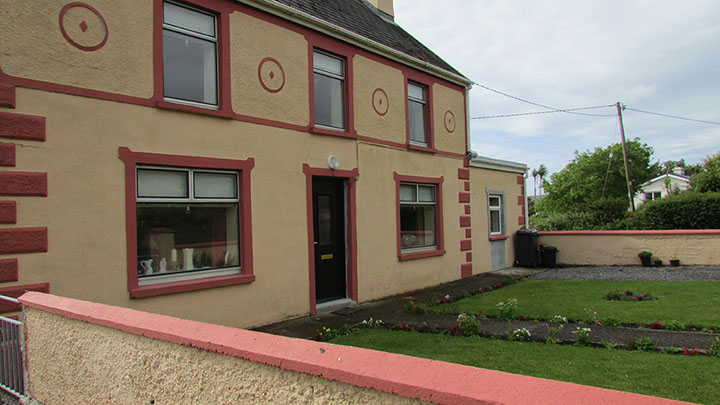
We drove down the road but were a little lost since our main identifier was two chalets, and there was nothing that looked like Swiss architecture anywhere in sight. There was a woman who had stopped to get her mail out of a box at the side of this narrow two-lane road bordered by tall fuchsia hedges. John stopped the car, and I hopped out. “Cá bhfuil an teach Leo Ó Murchú?” “You just missed it. He lives in that peach-colored two-story house right there.” She pointed up the road. “But Leo’s not there. His sister should be at home.” “Thank you!” John and I turned around and pulled into the driveway of the peach-colored house.

The house was empty. We drove back to the little market and, after more Irish—páipear, peann, clúdach—I wrote a note to Leo and left it in the mail slot. Besides identifying myself, I only said that we were staying in An Spéice the night. I figured he would call there. I wish I had asked the woman at the mailbox why Leo wasn’t at home. Maybe he was on vacation. We left An Bhauiltín the next day and headed to the Burren. Maybe I’ll try writing a letter to Leo with my street and email addresses included. Maybe I’ll write to him in Irish.

Go n-éirí an bóthar leat is do chosán cóngair.

May your journey, long or short, be a success.

Moycullen_Horsies-1-web

After a lovely visit with my cousin Gary at the University of Limerick, John and I headed north through the Burren in Clare and into Galway, stopping at Moycullen to see the Reilly family home. My grandfather left that home in 1900 when he booked passage from Cóbh to New York, and on to Pittsburgh.

Although still in the family, the house hasn’t been lived in for twenty years or more. A thick stone wall still sits before it, and the iron gate is rusted shut. John gave me a leg up to climb over the wall; then he climbed over, and I jumped into his arms on the other side, landing in a bed of nettles. The house with its faded red door sits not far from the stone wall. The windows are covered in thick wooden planking. To the west of the house is a smaller structure made of stone, maybe a cool place for storing potatoes and other vegetables.

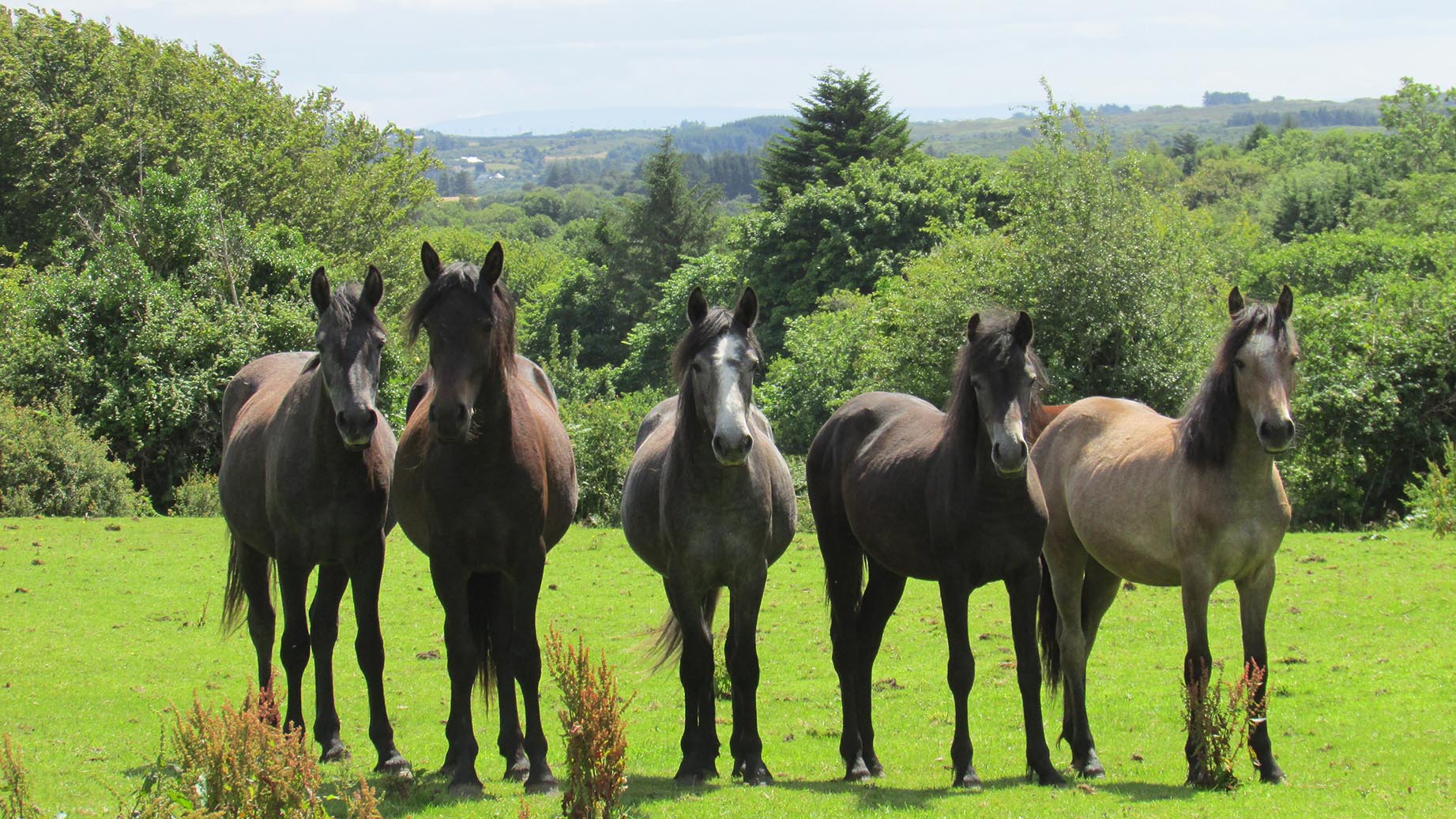
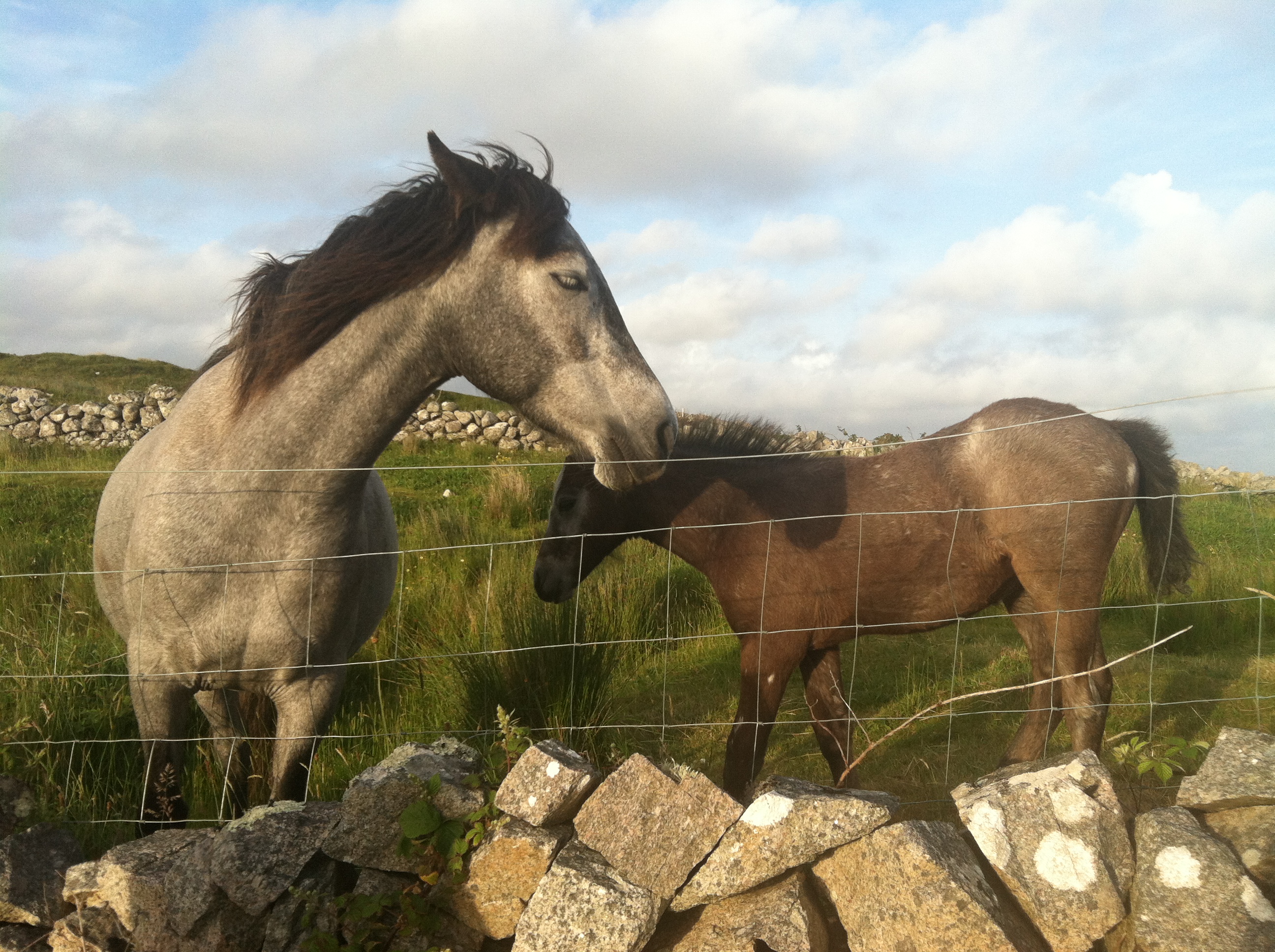
We walked between the house and the small stone structure in a deeply rutted path that ended in a large meadow overlooking the expanse of land that stretches for miles between Moycullen and the sea. The sky that afternoon was unusually blue, with bright white cumulus clouds, and across the field five horses grazed. As we walked into the field, each one in turn looked up. They walked across the field and stood in a perfect phalanx about twenty feet in front of us, waiting patiently. I would have given almost anything at that moment for a bag of apples.

After a bit the horses decided we bore no gifts, and they went back to grazing in the field. John and I walked to the edge of the field and back, climbing back up over the stone wall and into our black rental car. We headed toward the sea like my grandfather had done on foot, more than a century ago.

For weeks I’ve been studying Irish, the first language of my paternal grandparents. My studies haven’t been simply in Ireland, but in a village within walking distance—albeit a long walk—from both of their birthplaces. Every day I’ve had more questions for them and for my father. Did they speak to him in Irish when he was a boy? Did my father have any Irish? My grandparents were cradle Irish; they must have spoken it to each other at home.

Decades ago my father talked about having to be very quiet on Tuesday evenings when my grandfather entertained other “Gaelic scholars” in the parlor of their home in Pittsburgh. He remembered sitting on the stairs listening to them speak in Irish, most probably about literature and politics, which at that moment in history would have included the Gaelic Revival, the Easter Uprising, and the First World War. What I wouldn’t give, not only for a bag of apples, but to sit in that parlor listening to that conversation in Irish. I would have kept very still.

Ní hí an áilleacht a chuireann an corcán ag fiuchaidh.

Beauty does not boil the pot.

Ever since I left Conamara, I’ve had a terrible cold. I could say it’s a symptom of withdrawal, although I should admit that it was being widely shared even before I left. I’ve tried to boost my body’s natural defenses with a daily dose of 1,500 mg of Vitamin C, but I’m about to admit defeat. Alice, who runs An Spéice, my B&B here in the wild west end of An Chorca Dhúibhne, just offered me a box of black currant flavored Lemsip Max. It’s a powder you put in boiling water, because almost everything good here is potable: Murphy’s, Jameson’s, Green Dot (uisce beatha), Guinness, and Lemsip.

When Alice handed me the Lemsip, I remembered standing in the kitchen of the house in An Cheathrú Rua with our bean an tí Lucy when the first signs of this slaghdán started. She handed me a box of Lemsip then, and I declined it. After all, I’m not sure what’s in Irish medicine. It’s likely to be filled with fairy dust. Or possibly narcotics. I think both might be easier to come by here since pharmacists are called chemists. Wasn’t Walter White a chemist?

After I took the Lemsip from Alice, I felt a twinge of disloyalty to Lucy, whose role in my stay in Conamara is substantial. Every day for three weeks, Lucy fed seven of us three meals a day, including a big basket filled with delicious lunches that she brought to school every day. She worked from early morning ’til late at night, so that we could sit on our tóeanna and learn Gaeilge. She had a seemingly infinite supply of patience for our halting Irish, listening to our awful pronunciation and bizarre sentence structure without batting an eye.

But it wasn’t just our Irish for which she had patience. Lucy saw the best in each of us, and this could not have been easy. We were seven people of varying ages, backgrounds, and lifestyles living with a family of five. We ate together, studied together, and sat in class all day together. Only one of us didn’t share a room. One evening Lucy laughingly suggested she might “knock the corners” off one of us. It sounded like a fairly good idea at the time. Everyone could benefit from being a little more well-rounded, right?

All this nourishment and care came from a woman who, on our second day, had broken her leg. At first, she was told it was a sprain, but after two weeks, it was clearly not healing. Just before we left, she went to a specialist to find that two bones were broken. She came home wearing a big black boot and proceeded to run around taking care of us still.

Now there are seven more lucky mic léinn in Lucy and Ciarán’s house being fattened up for Irish. I hope they appreciate the wonderful care they’re being given. I hope they eat all of Lucy’s delicious meals happily and carry their dishes to the kitchen. I hope they don’t get lost coming home from the pub and call Ciarán at midnight for help (like we did on the first night!).

By the way, Lemsip, according to Wikipedia, is mainly paracetamol, which, in the U.S., goes by the brand name Tylenol. Maybe there’s still time to get to the chemist for some fairy dust. I’m not sure this Lemsip is going to be strong enough.

Níl duine ná deoraí ann.

There is no exile here. Before I opened my eyes this morning, I heard the sound of Lisa’s voice, “I think it might be time…” Shower. Pack. The last breakfast. Sweet good-byes and a final bus ride into Galway for the whole bedraggled band of Gaeilgeoirí.

No more of Lucy’s fresh scones and hot tea. No more walking into class 15 seconds before the teacher. No more conversations about when the wash might return. No more walks home from school waylaid by the sight of the Twelve Bens draped low in the sky. No more Conamara sean nós or céilis. No more welcomes into the warmest house in Conamara with a turf fire to share a meal and study by.

Some parents encourage their children to travel the world after college. That is something to which we might all aspire. Travel. Education. One in the same. Sometimes we can’t help but see no farther than the end of our noses. When I come to Ireland, I always think I am coming to my grandparents’ home. That in some way, I am coming home. But this is a different culture, indeed, and none of us purely represents the culture from which we came. We are African Americans. We are Mexican Americans. We are Irish Americans. But Janis Joplin sang the blues, and Martha Stewart cooks tamales. We retain small bits of our grandparents’ or our great grandparents’ cultures, but we become something altogether different.

In spite of that, we were each taken in as if we had been away from Conamara for far too long. We were fed, nurtured, and taught. Like Peigín Leitir Móir’s husband, who came home to find a son he had never met, we may not recognize the customs, but we are forgiven and cherished just the same.

Ní mhaireann aon rud ach seal.

Nothing lasts forever.

Tomorrow marks the beginning of our last full week in An Cheathrú Rua, and here at the Ó Fhatharta home, we are all feeling a twinge of regret that the time has gone by so quickly. There is a note of homesickness on the part of the fledglings, especially as the 4th of July approaches, but for the most part, the time has flown.

Since Inis Oirr we’ve had a comprehension exam, followed by an evening in Galway — ag spaisteoireacht on Shop Street, then Fish and Chips at the Kings Head, followed by Guinness and Andy Warhol’s recommended 15 mintes of fame, or in this case, the nearness of fame, when we talked to Leo Moran, the guitarist for the Saw Doctors, at Tígh Neachtain.

In addition to the cupla focail I’m taking with me next Friday, I’ll be hauling a large suitcase full of stories.

Tarraingíonn scéal scéal eile.

One story leads to another. 

Inis_Oirr_Ancient_Church-2-web Inis_Oirr_Ancient_Church-web Inis_Oirr_Elderberry_Tree-web Inis_Oirr_landscape-web

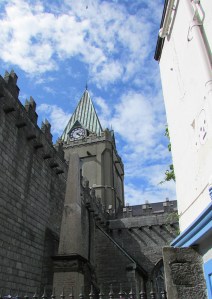
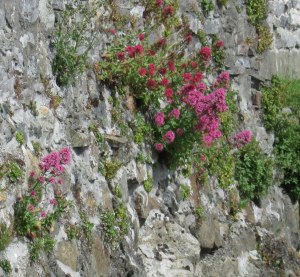
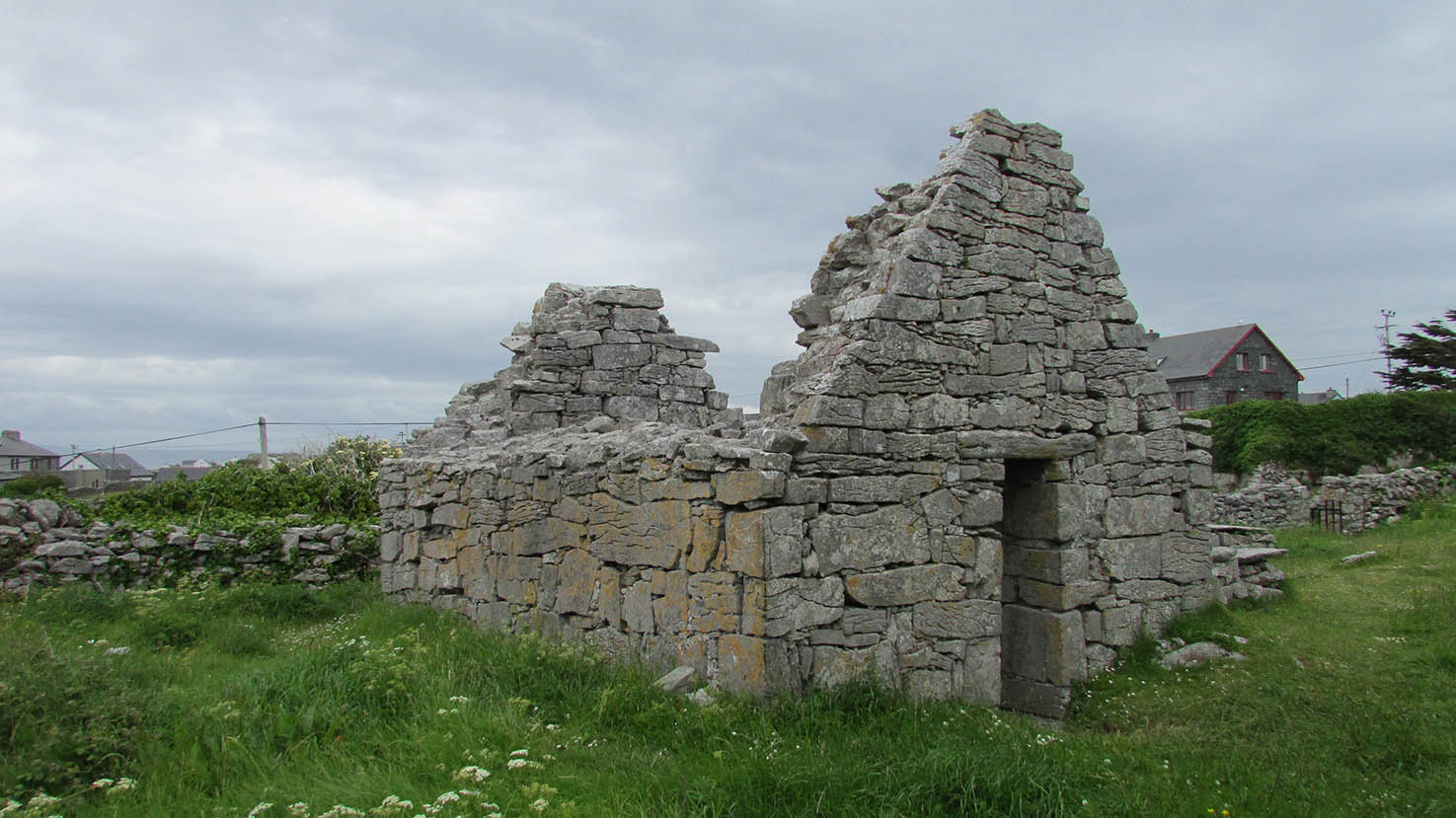
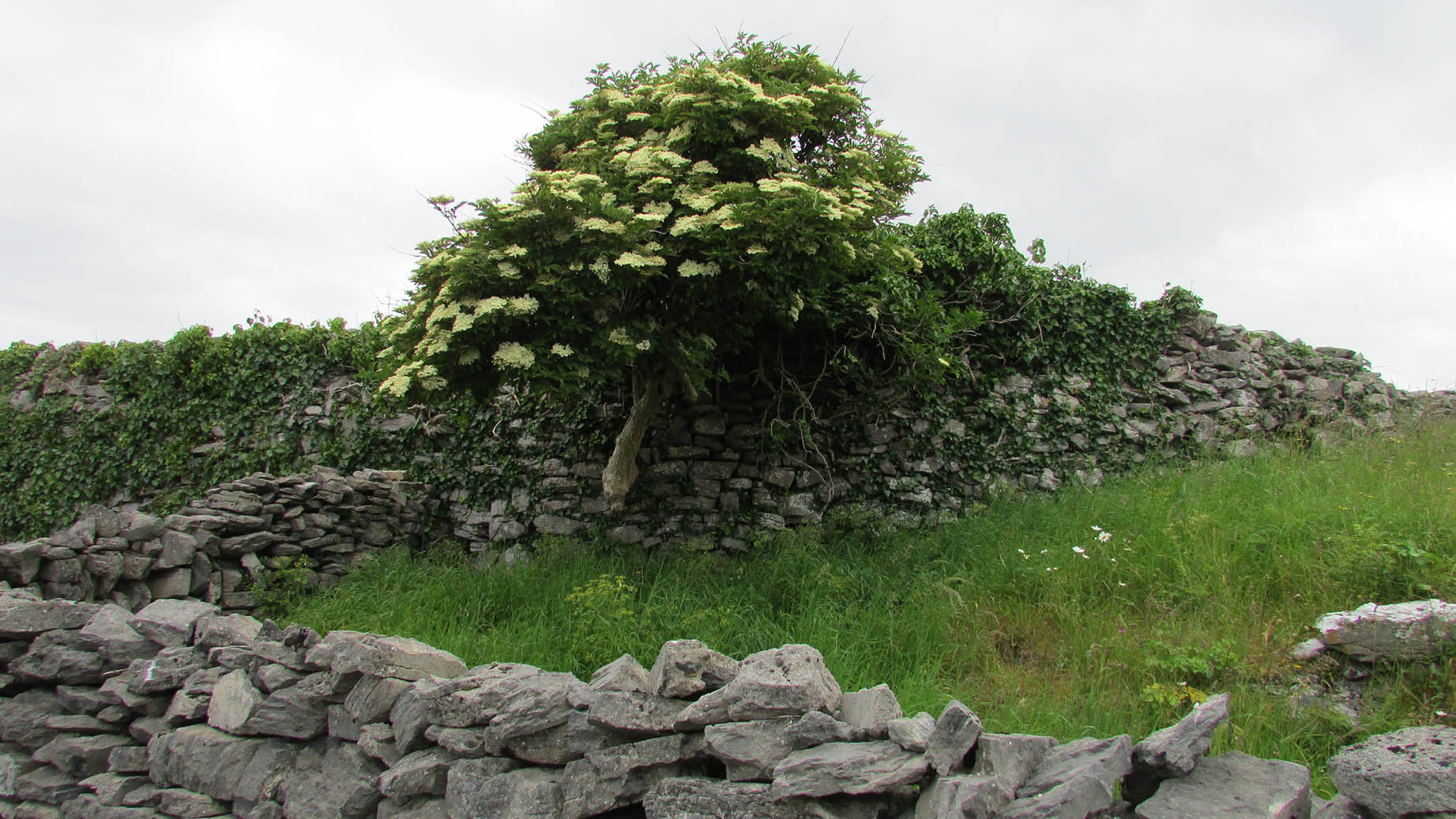
Yesterday we had a great tour of Inis Oirr, the easternmost of the Aran Islands. Here are a few photos of Saint Gobnait’s 6th century church, the landscape, and an elderberry tree. The island was of strategic importance in centuries past and had its fair share of smugglers and pirates, as well. It’s part of County Galway now but has gone back and forth between Galway and Clare in years past. Irish is still the first language in the Aran Islands.