In time, a mouse may bite a cable in two.
 When I was in my twenties, I traveled for several months through Europe with a backpack, hiking boots, a Let’s Go travel guide, and my dear friend Lisa. The eighth country we visited was Ireland. We were young and foolish, so we hitchhiked from Waterford to the Dingle Peninsula, which I now know as Corca Dhuibhne.
On our way out of Dingle, we hitched a ride as far as Limerick with a fellow named Leo Murphy and his friend Brian Walsh. On that two-hour trip, they taught us to sing “The Reason I Left Mullingar” and “From Clare to Here” by the Furey Brothers. We stopped at Bunratty Castle and drank Murphy’s on tap and ate pub grub. We decided against visiting the Blarney Stone–the major deterrent being that Irish boys liked to drink beer and relieve themselves on the stone late at night. By the time we finished dinner, it was too late to get on the road, so Lisa and I slept on Leo’s living room floor. In the morning, he took us to the bus station, and we left for Galway.
Leo lived in Limerick because he worked nearby at Shannon Airport as an air traffic controller, but he was born and raised in Baile na nGall, known in English as Ballydavid, on Corca Dhuibhne. His training and his apartment were subsidized by the Irish government as part of a program to support native speakers of Irish. Leo learned to speak English when he was 14 years old.
After I left Ireland, I wrote Leo to thank him for offering his home to two travelers, and I asked him if he had a suggestion for a book I might get to learn Irish. Exercising that amazing Irish hospitality, even from afar, he sent me a book and a set of tapes called “Teach Yourself Irish.” I found them quite daunting on my own. I leant them to my brother Kevin and never saw them again. That was it for my Irish studies for several decades.
I did hear from Leo once more, or at least I heard of him. My mother answered the phone one day a few years later to hear a thick Irish brogue. (By the way, bróg means shoe in Irish; I have no idea how it came to be used for “accent.”) Leo was visiting his sister in New York. He would only be there a few days, but he wanted to call while he was on this side of the Atlantic. They talked for half an hour. She found him utterly charming and was disappointed he wouldn’t be coming to Washington on that visit. Mise, freisin.
The day my studies ended in Conamara, I headed for Ballyferriter for a week-long course in the Kerry Gaeltacht. It was, I discovered, just a few kilometers from Baile na nGall. During my studies I had no car, and I hadn’t an Irish phone, so I couldn’t get to that town or try to call Leo. Besides, I was sure he would be in Limerick or somewhere else. Why, I thought, would he return to this slice of heaven having seen a city like Limerick?
After my studies were done, John came to An Bhuailtín with a rented car, and we spent a few days hiking and touring the unimaginably green beauty that is West Kerry. We drove near Baile na nGall one evening to have dinner at a restaurant called The Old Pier, which was really more like an old house with a couple of rooms filled with tables jammed with people on holiday, eating local seafood and fresh veg. We couldn’t figure out which cluster of houses was Ballydavid. We talked about how we might find Leo but weren’t quite sure how to go about it.
Alice said we should visit the Gallurus Oratory, a perfectly preserved seventh century chapel built of thick slabs of sandstone fitted together seamlessly by monks who used no mortar. Once we saw the oratory, she said, go across the street to TP’s house. He owns the pub in Baile na nGall and “he knows everyone.” He would know how to find anyone who had ever lived in that town, she said. John, being of more reserved stock than I, was hesitant to stop at a stranger’s house and ask about a person I hadn’t seen in thirty years.
It was our last full day in Corca Dhuibhne, so we drove back to the area we thought was Baile na nGall. There were a couple of streets intersecting the main road with a market and church at the center. I pulled into the church parking lot, figuring I could ask someone inside—if I could find anyone. If not, we would pray for revelation.
We walked into the church and sat in a pew at the back. I grabbed a Sunday bulletin (always!), which was in Irish, of course. John knelt to pray and, after a few moments, I watched as two men walked into the nave. One climbed up on some scaffolding. I walked quietly up the center aisle and stood at the communion rail. The men were busy talking in Irish about the painting they were about to do.
“Gabh mo leiscéal,” I said just loud enough for them to notice. We were right next to the altar, after all. “Hello,” the man on the floor replied, spotting me for a Yank. “Táim ag lorg an fear darbh ainm Leo Ó Murchú. An bhfuil aithne agat air?” I said. “Aithníonn.” He went on to explain that Leo lived in his mother’s house, just beyond what he referred to in Irish as two “chalets.” I think it must be a Kerry word for cottage. But there are a lot of Murphys in West Kerry, so I said, “Seo é Leo Ó Murchú, the air traffic controller?” “Is ea. Is ea.”
It was then I realized I was so focused on speaking and understanding Irish, that I had no idea in what direction these chalets were. So I looked at the back of the church and said, “Ar chlé?” pointing to the left. At that point, he and the fellow on the scaffolding started giving me directions at once in rapid fire Kerry Irish, and one of the phrases I caught in the jumble was “Téigh síos an bóthar.” (Go down the road.) I must have looked fairly distraught, because the fellow on the ground said quietly in English, “Yes, just down the road past the two chalets.” “Go raibh maith agat,” I said and smiled broadly, feeling pretty proud of myself for navigating what seemed to me a somewhat complex conversation with two locals, who hadn’t been hired to teach me!
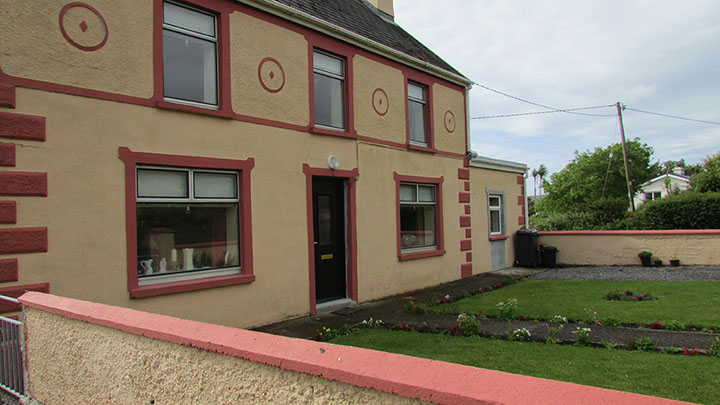
We drove down the road but were a little lost since our main identifier was two chalets, and there was nothing that looked like Swiss architecture anywhere in sight. There was a woman who had stopped to get her mail out of a box at the side of this narrow two-lane road bordered by tall fuchsia hedges. John stopped the car, and I hopped out. “Cá bhfuil an teach Leo Ó Murchú?” “You just missed it. He lives in that peach-colored two-story house right there.” She pointed up the road. “But Leo’s not there. His sister should be at home.” “Thank you!” John and I turned around and pulled into the driveway of the peach-colored house.
The house was empty. We drove back to the little market and, after more Irish—páipear, peann, clúdach—I wrote a note to Leo and left it in the mail slot. Besides identifying myself, I only said that we were staying in An Spéice the night. I figured he would call there. I wish I had asked the woman at the mailbox why Leo wasn’t at home. Maybe he was on vacation. We left An Bhauiltín the next day and headed to the Burren. Maybe I’ll try writing a letter to Leo with my street and email addresses included. Maybe I’ll write to him in Irish.
 Learning Irish in Conamara
Your words flow seamlessly off the paper just as the froth off a pint of Guinness. Such a charming story Thanks
LikeLiked by 1 person
Great story. Maybe Leo was at the airport to see your plane to safety.
LikeLiked by 1 person
Dia dhuit Kate, chuaigh do scéal ar thóir mo dhreathár Leo go mór dom. Ba bhreá liom teangmháil a dhéanamh leat má chíonn tú an teachtaireacht sa. This amazing story was sent to me on WhatsAp. I am still trying to ascertain where it was found. Lé dea-ghuí. Áine
LikeLike
Áine, tá sé chomh iontach cloisteáil uait. Scríobh mé teachtaireacht ríomhphoist chugat. An bhfuair tú é?
LikeLike
Áine,
An bhfuair tú mo theachtaireacht? Sheol mé ríomhphost chugat nuair a chonaic mé do theachtaireacht.
LikeLike